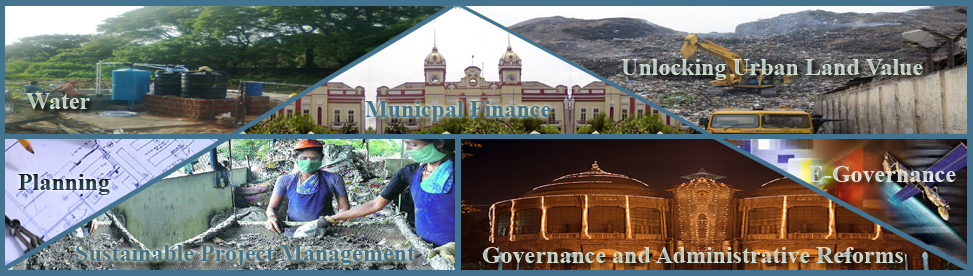
ICRIER’s program on Urbanisation, capacity building and knowledge dissemination involves research on seven thematic areas around which capacity building efforts will take place. The themes are: (i) Water and Sanitation including waste water treatment and solid waste management, (ii) Municipal finance, (iii) Unlocking urban land value, (iv) Planning: land use, zoning and transit oriented development, (v) Governance and Administrative Reforms, (vi) E-Governance, and (vii) Sustainable Project Management and Implementation.
Research will take cognizance of the current debates in the policy and academic literature. It will have two components: (i) selected case studies to draw out lessons about urban policy and practice from the patterns that emerge on the ground, and (ii) reviews that present a cutting edge state of the sector assessment for each theme, using Indian as well as international experiences of best practices.
All are working titles.
| 1. Water, Sewerage, Waste Water Treatment, Solid Waste Management |
Solid Waste Management in India
by Isher Judge Ahluwalia and Krishnaswamy Kasturirangan
This paper presents an overview of the state of solid waste management in some selected Indian cities. It discusses the existing legislative and administrative structure for managing solid waste that is currently in place at the national and sub-national levels and analyses the linkages between them, with special emphasis on how the authorities responsible for handling solid waste are approaching this task. Challenges of scale and capacity building are also discussed and some options for converting waste to energy are presented.
Scaling Up Urban Water Supply 24×7: Where are the Opportunities and Barricades?
by Deepak Santhanakrishnan and Isher Judge Ahluwalia
Despite demonstrated success in providing continuous water supply 24 hours, 7 days a week in some pilot areas in some Indian cities, scaling up of these initiatives and/or replicating these examples has proved challenging. Despite financial investments in the sector by the government, donor organisations, and sometimes the private sector, results have fallen short of the service delivery standards that are required and promised.
Existing funding arrangements for such projects through urban local governments, public sector institutions such as the Delhi Jal Board, and public private partnerships are examined, as is the experience with setting user charges to cover costs. The study takes note of the political economy of the urban water supply sector. More broadly, it covers the challenge of governance and the need for administrative reform for better service delivery.
The potential for scaling up is evaluated against the practical realities on the ground, and thereby increasing the effectiveness of development interventions. The case studies drawn from Indian cities provide guidance on how to bridge the gap between testing innovation and bringing projects to scale.
Towards Achieving Efficiency in Service Delivery of Water
by Kanak Tiwari
This paper looks at efficiency of water supply in Indian cities, which is a basic service. It does so in the context of challenges of financial sustainability and environmental sustainability. It discusses the determinants of efficiency of urban water service delivery, focusing on both technical and institutional factors. As a conclusion, the paper would attempt to highlight a few central recommendations, both at policy level, and for local service delivery.
| 2. Municipal Finance |
Making Cities Creditworthy
by Anand Sahasranaman
Literature on making cities creditworthy for accessing debt markets points to two sets of reforms that can address the issue: one, a set of fundamental reforms that need to be implemented across cities in the country like implementing computerised double entry accounting standards, improving efficiency in the collection of taxes, especially property tax, solving the problem of weak staff capacity and; two, a set of legal/constitutional reforms that provide for instance, adequate financial autonomy along with the functional devolution provided by the 74th CAA; a national legal policy on how local governments can access debt markets and a bankruptcy framework for ULBs. While the path to making cities credit worthy is clearly laid out, there is lesser understanding of how policy can nudge/incentivise cities to tread this path. To address this gap in literature, we propose to study international experience as well as the current state of affairs in selected in Indian cities with the objective of framing a set of policy options for improving credit worthiness of cities.
Property Taxation: A Comparison of Delhi and Bangalore
by Simanti Bandyopadhyay
Property tax is a major source of revenue for urban local bodies. Adequate coverage, a proper methodology of assessment of the tax, and of changing valuation of properties in the face of rising prices, are some of the major factors that affect the ability of the urban local body to realize the potential of revenue from property taxes. This study attempts to identify the factors responsible for the differences in performance of Delhi and Bangalore. In Delhi, a transition from rental valuation to unit area based valuation has not been successful in bringing in the desired revenue, while Bangalore has achieved greater success, even as there are similarities in the approach to reform and both cities have used GIS and IT. The interaction of changes in policy and administrative reforms to support the change in determining outcomes emerges very clearly from this study.
| 3. Unlocking Urban Land Value |
Unlocking Land Value for Financing Urban Development in India
by Isher Judge Ahluwalia
This study highlights the importance of unlocking land value in financing urban infrastructure development. Considering the large financing requirements of urban infrastructure and the strained finances of urban local bodies as well as state governments, instruments such as tax increment financing, betterment levies, development charges and special assessments are examined for their potential in unlocking urban land value in India’s urban infrastructure development. The study presents evidence from international experience in this area.
Land Based Financing in Metropolitan Regions in India: the case of Hyderabad and Mumbai
by V.K. Phatak and Sahil Gandhi
One of the major challenges policymakers have to address is the infrastructure bottlenecks in major cities and the shortfall in financial outlays to overcome them. Given the plethora of unfunded mandates confronting urban local governments, one of the recommendations made by HPEC (2011) is to leverage urban land to finance infrastructure needs of these cities. This study focuses on land based financing in Indian regions. The study would examine Land Based Fiscal Tools implemented on urban land by the principal local body and the development authority in selected metropolitan regions, and the contributions to the revenues of the implementing agencies. Further, the study also aims to understand the land value capture used in the metro rail development in selected metropolitan regions. It would discuss legal issues, if any related to the implementation of these tools. The study would attempt to propose an appropriate design of these tools given the various constraints in India.
| 4. Planning: land use, zoning and transit oriented development |
Planning for Urban Development in India
by Isher Judge Ahluwalia
This study presents a brief overview of the present approach to urban planning in India. It highlights the importance of an integrated approach to the planning of transportation and land use. It presents the conundrum of high population density and low FSI (Floor Space Index) in Indian cities and calls for integrating urban design into planning for urban development. The challenges of inclusion of low-income households in urban planning in the light of the political economy of land acquisition in India are also examined. The study presents alternative models of land assembly and the role of instruments such as impact fee or betterment charges for revenue mobilisation in the course of putting urban infrastructure in place.
| 5. Governance and Administrative Reforms |
Capacity Building and Administrative Reforms
by M. Ramachandran and Isher Judge Ahluwalia
In addressing the challenges of urbanisation in India, there is broad consensus on the need to develop institutional capacity as well as human skills to plan, implement and manage the development of urban infrastructure and ensure the delivery of services in Indian cities and towns. Capacity building is required across all levels of government in the urban sector, especially urban local bodies. This study highlights the challenges of capacity building and puts forth some specific recommendations. In doing so, it identifies lessons learnt from the experience of JNNURM (Jawaharlal Nehru National Renewal Mission), a flagship program of the Government of India which ran its course from 2005 to 2014. Besides recommending a major focussed role for the Government of India, the study also calls for state level initiatives and the need for establishing municipal cadres.
Policy Initiatives for Promotion of Urban Agglomeration in India
by Sabyasachi Tripathi
This study attempts to identify which policies can help to promote urban agglomeration for rapid and sustainable economic growth in India. It covers the areas of transport infrastructure, efficient land use and its integration with transport planning as well as administrative reforms for better delivery of public services. Only when ease of living is improved together with ease of doing business can agglomeration economies be harnessed.
| 6. E-Governance |
Using GIS for Greater Efficiency in Operations and Better Delivery of Services by Urban Local Bodies in India
by Tanushree Bhan
This paper explores the use of GIS technology to improve the system of service delivery and bring about transparency and accountability in the functioning of urban local bodies. A few good practices have been deconstructed to identify the role of GIS and the enabling factors that have led to a smooth transition from a manual system to an IT enabled administrative set-up of operations as well as service delivery in Indian cities.
E-Governance for strengthening governance: achieving efficiency and transparency through e-business procurement and e-tendering in urban local bodies in India
by Sirus Joseph Libero
The use of information and communication technology (ICT) for transparency, accountability, and efficiency in delivery of public services was one of the mandatory reforms for the urban local bodies (ULBs) under JNNURM. The National e-governance plan aimed to put in place mechanisms, which would facilitate the use of technology in order to provide more effective services to the citizens. Accordingly, a number of urban local bodies have instituted e-governance projects with the use of ICT to strengthen governance. This paper aims to assess the maturity of the e-governance program in Indian ULBs by focusing on the e-business procurement and e-tendering. It will look at various initiatives undertaken by ULBs and assess the successes and difficulties faced in implementation. The focus would be on analysing the factors (transparency in the e-tendering process, ease of access, design of the process etc) which led to the success or failure of these initiatives, to gather lessons for other ULBs.
| 7. Sustainable Project Management and Implementation |
Approaches to Sustainable Management and Implementation of Urban Infrastructure Projects in Public Transport
by Deepak Santhanakrishnan, Ranesh Nair and Pavan Kumar Ankinapalli
The rapid growth in India’s urban population has put strain on public transport projects. In particular, they are often snowed under by undependable services, congested roadways and slow mobility. This study attempts to answer some pressing issues in the public transport sector: Firstly, understanding the project life cycle and sustainable factors for two mass transit projects. Secondly, identifying the potential risks incurred, cost overruns and flexible intervention strategies that accounts for the uncertainties and scheduled analysis. Lastly, this paper suggests various combinations of policy packages that are most effective for motivating sustainable project management implementation.
| Other Research Studies |
Creating Jobs in India’s Organised Manufacturing Sector
by Radhicka Kapoor
The unprecedented rate of urbanisation in India is creating two acute crisis -an employment and poverty crisis and an infrastructure and service delivery crisis. While the latter is already the focus of research in our major thematic area on 'Urbanisation-Preparing for the Challenges of the 21st Century', the former has not been examined so far. For our cities to emerge as engines of growth, the process of structural transformation associated with urbanisation, wherein jobs are reallocated from low productivity to high productivity sectors, must occur. The generation of productive employment is, therefore, central to the process of fostering inclusive economic growth, and is a key feature of our research agenda. In the light of this, we have prepared a research proposal on ‘The Challenge of Productive Employment Creation in Urban India’. In the course of this study, we will attempt to answer some pressing issues: How do we provide high productivity jobs for the rapidly rising urban population? How do we energise jobs in manufacturing and how can governments create an enabling environment for productive employment generation in the manufacturing sector? How can labour policies be re-designed to reduce growth in the casualisation and informalisation of jobs? How can India take advantage of its demographic dividend which has the potential of increasing its growth rate and labour force? This study will provide key insights into how productive employment generation will drive urbanisation and be core to India’s future, productivity and economic growth.