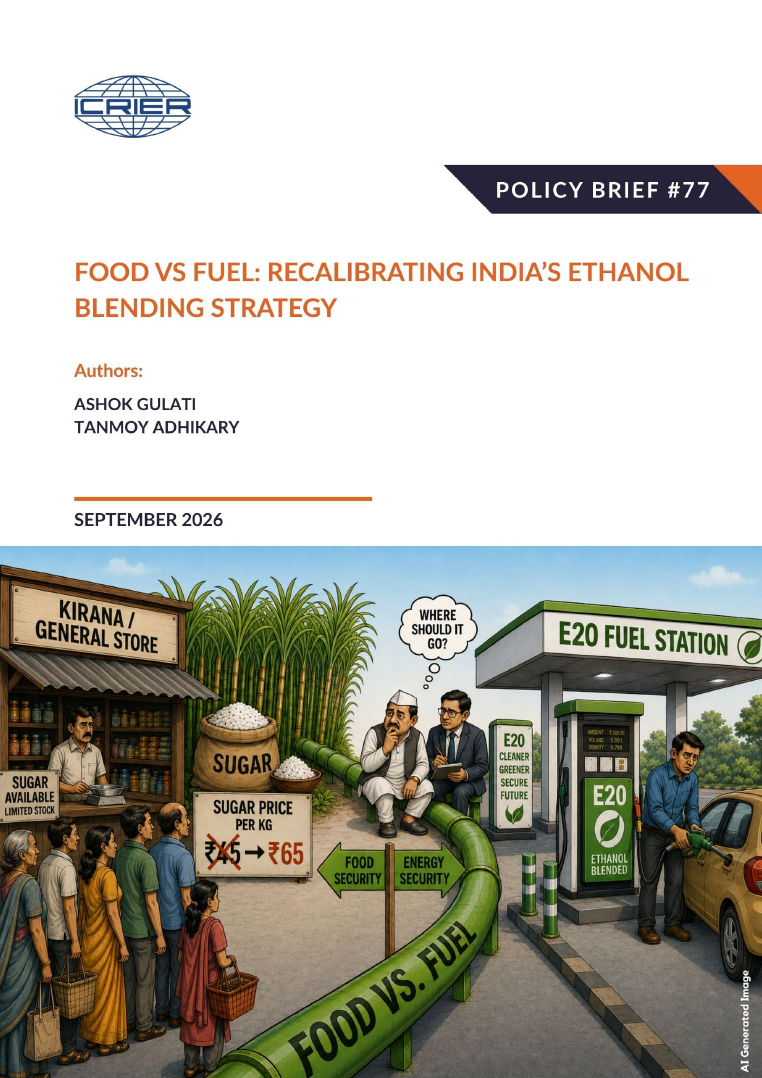
India has rapidly expanded its Ethanol Blended Petrol (EBP) Programme, which promotes blending of ethanol in petrol. The ethanol is produced from agricultural commodities such as sugarcane, maize and surplus rice. The programme aims to reduce dependence on imported fossil fuels and increase the use of domestically produced renewable fuel. The Government had a target of E20 i.e., petrol should contain up to 20 per cent ethanol by volume. India achieved this target in the Ethanol Supply Year (ESY) (November to October) 2025–26, five years ahead of the original schedule. During 2019–20 to 2025–26, ethanol supplied to oil marketing companies increased from 1.73 billion litres (173.03 crore litres) to a projected 12 billion litres (1,200 crore litres). This represents a CAGR of about 38 per cent over six years. In contrast, production of the agricultural commodities like sugarcane, maize and rice, used to produce ethanol grew much slowly. During the same period maize production grew at 11.4 per cent CAGR, rice at 4.4 and sugarcane at 5.1 per cent. This widening gap in growth of ethanol demand for blending and the supply of feedstock to meet that demand is creating a growing food-versus-fuel trade-off. The trade-off is already evident in the sugar market. Where a low opening stocks and lower production have coincided with a 44 per cent rise in modal retail sugar prices, from ₹45 per kg in July to ₹65 per kg by 29 August.
The brief examines whether the benefits of replacing petrol with ethanol justify the economic, energy and environmental costs of producing the agricultural feedstocks required for E20. The brief compares India’s experience with that of the United States and Brazil. It reviews existing evidence on the energy and environmental performance of ethanol, and examines how different feedstocks are priced. The findings suggest that current assessments and procurement prices do not adequately capture the full economic and environmental cost of producing ethanol. In particular, subsidised fertiliser, electricity used for irrigation, water use and the opportunity cost of diverting food and feed commodities are largely absent from existing assessments. For example, the Food Corporation of India (FCI) procured rice supplied to ethanol distilleries are priced at ₹2,320 per quintal which is substantially below its estimated economic cost of ₹4,173 per quintal in 2025-26.
The brief therefore argues for a more adaptive and market-oriented approach to the ethanol blending policy. It recommends using sugar imports as an immediate buffer during shortages; limiting FCI rice largely to genuine surplus stocks while moving its pricing closer to at least the acquisition cost; making feedstock allocation responsive to agricultural conditions; greater openness to feedstock and ethanol imports. Most importantly, it calls for an India-specific well-to-tank assessment of sugarcane, maize and rice. A study that incorporates their full energy, environmental and economic costs, including implicit subsidies. Reforming distortionary input subsidies and allowing ethanol producers greater flexibility to choose feedstocks based on their true market costs could improve efficiency. In the longer term, second-generation ethanol from agricultural residues and other non-food biomass offers a way to expand ethanol use without intensifying the competition between food and fuel.