India has emerged as a major player in global shrimp trade following the expansion of Litopenaeus vannamei aquaculture since 2011, supported by access to imported broodstock and improvements in hatchery technology. As the world’s second-largest shrimp exporter after Ecuador, India recorded seafood exports of USD 8.46 billion in 2025–26, of which frozen shrimp contributed USD 5.6 billion (66.2 per cent). Sustaining this export competitiveness requires a transition from production-led expansion towards efficiency-driven, sustainable and traceable aquaculture value chains. This entails addressing constraints across the entire production and marketing system, including broodstock sourcing, seed quality, feed-use efficiency, disease surveillance, energy management, harvesting decisions, processing infrastructure and market integration.
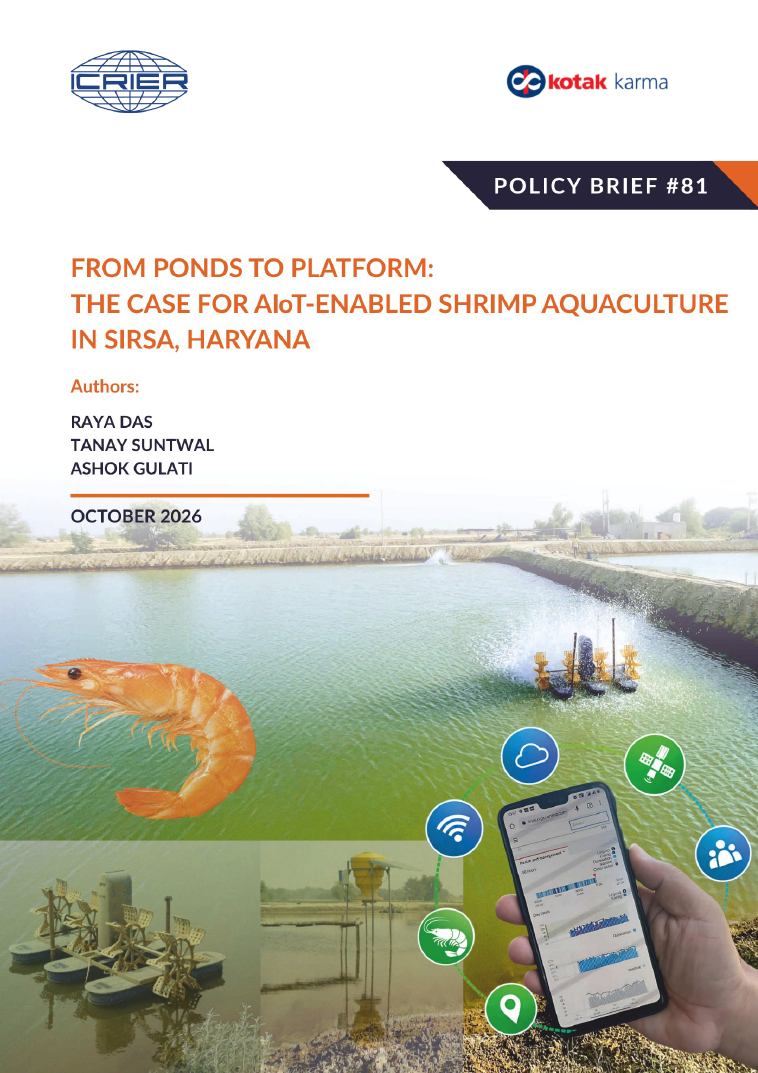
Against this backdrop, the brief examines the potential of Artificial Intelligence of Things (AIoT) technologies to transform inland saline shrimp aquaculture, using Sirsa district in Haryana as a demonstration cluster. Despite rapid expansion in shrimp cultivation, farmers in Sirsa face high feed and energy costs, production and disease risks, limited technical capacity, inadequate institutional credit, dependence on coastal input markets and the absence of local processing infrastructure. Evidence from Vietnam, Indonesia and India’s emerging aquaculture technology ecosystem indicates that AIoT-enabled precision feeding, real-time monitoring, automation and predictive analytics can improve resource-use efficiency, strengthen disease-risk management and generate verifiable farm-level data for traceability and financial services. Farm-level evidence from the ICRIER–Kotak Karma AIoT pilot in Sirsa demonstrates these potential gains.
The AIoT-enabled treatment pond achieved approximately 30 per cent lower Feed Conversion Ratio (FCR) than the control pond, alongside improvements in productivity, labour efficiency and energy management. Estimated annual net returns increased from INR 5.63 lakh per acre under conventional shrimp farming to INR 10.40 lakh per acre with AIoT integration. Beyond farm-level profitability, continuous production monitoring and predictive disease-risk assessment can reduce uncertainty, improve crop survival and strengthen supply reliability, thereby creating conditions for investment in processing infrastructure and integration into higher-value export markets.
However, translating these gains into cluster-wide adoption requires institutional and financial innovations beyond technology deployment. The brief identifies subscription-based Hardware-as-a-Service models, data-backed credit and insurance, targeted PMMSY support, farmer aggregation and interoperable digital traceability systems as critical instruments for overcoming adoption barriers. It proposes a time-bound National AIoT Mission, positioning Sirsa as a demonstration cluster for scaling AIoT adoption through a competitive, platform-neutral framework. Such an approach can improve farmer incomes, strengthen supply-chain reliability and facilitate India’s integration into high-value global seafood markets by leveraging opportunities under the India–UK and India–EU free trade agreements (FTAs), alongside evolving international traceability and sustainability standards.