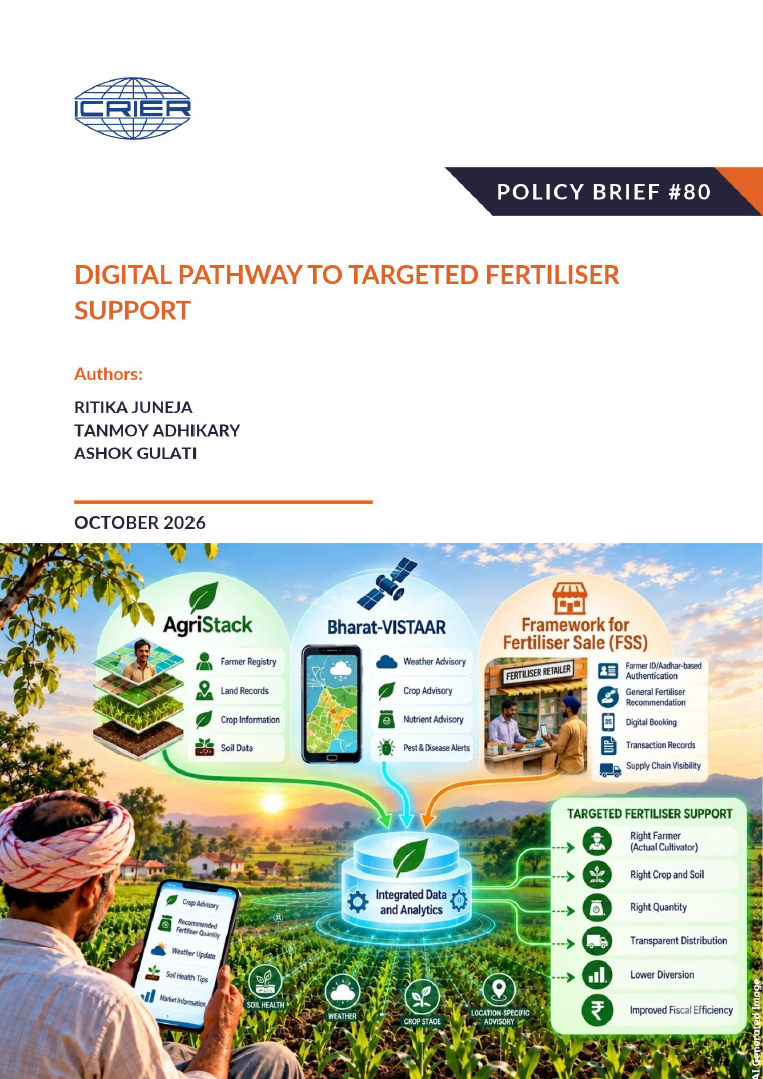
India’s fertiliser subsidy has kept fertiliser affordable and supported output, but it has left nutrient use out of balance. The Nutrient Based Subsidy (NBS), introduced in 2010 to correct this, covers phosphatic and potassic fertilisers, while urea remains outside it at a more or less fixed price. Between triennium ending (TE) 2009-10 and TE 2024-25, nitrogen use at national level moved from 7 per cent below its recommended dose to 6 per cent above it. The phosphorus deficit narrowed only from 29 to 22 per cent, and the potassium deficit deepened from 48 to 72 per cent. The all-India N:P:K ratio of 10.5:4.1:1 compares with a normative 2.8:1.5:1. Eleven of 20 major states, accounting for 39 per cent of gross cropped area, over-apply nitrogen, while all but three under-apply phosphorus and every state under-applies potassium. The central finding is that this is a relative-price problem, and what farmers know explains little of it. The consequences extend beyond nitrogen, so policy should be judged by the balance among nutrients, whatever the volume of any one fertiliser applied. Subsidy design also does not operate in isolation: Minimum Support Price (MSP) procurement and subsidised power lock Punjab and Haryana into a rice-wheat rotation, more input-intensive than the region’s water endowment can sustain. The subsidy bill peaked at INR 2.51 trillion in 2022-23, and the disruption at the Strait of Hormuz could take it to INR 2.42–3.32 trillion in 2026-27. The brief recommends a direct cash transfer to farmers that is neutral across nutrients and crops, with the savings directed to fertigation and drip irrigation. It also recommends a farmer-level successor to PM-PRANAM, the incentive scheme for states that reduce fertiliser use, which assesses reductions product by product, and a shift in products and practice built on the 4Rs of nutrient stewardship (right source, right rate, right time and right place).